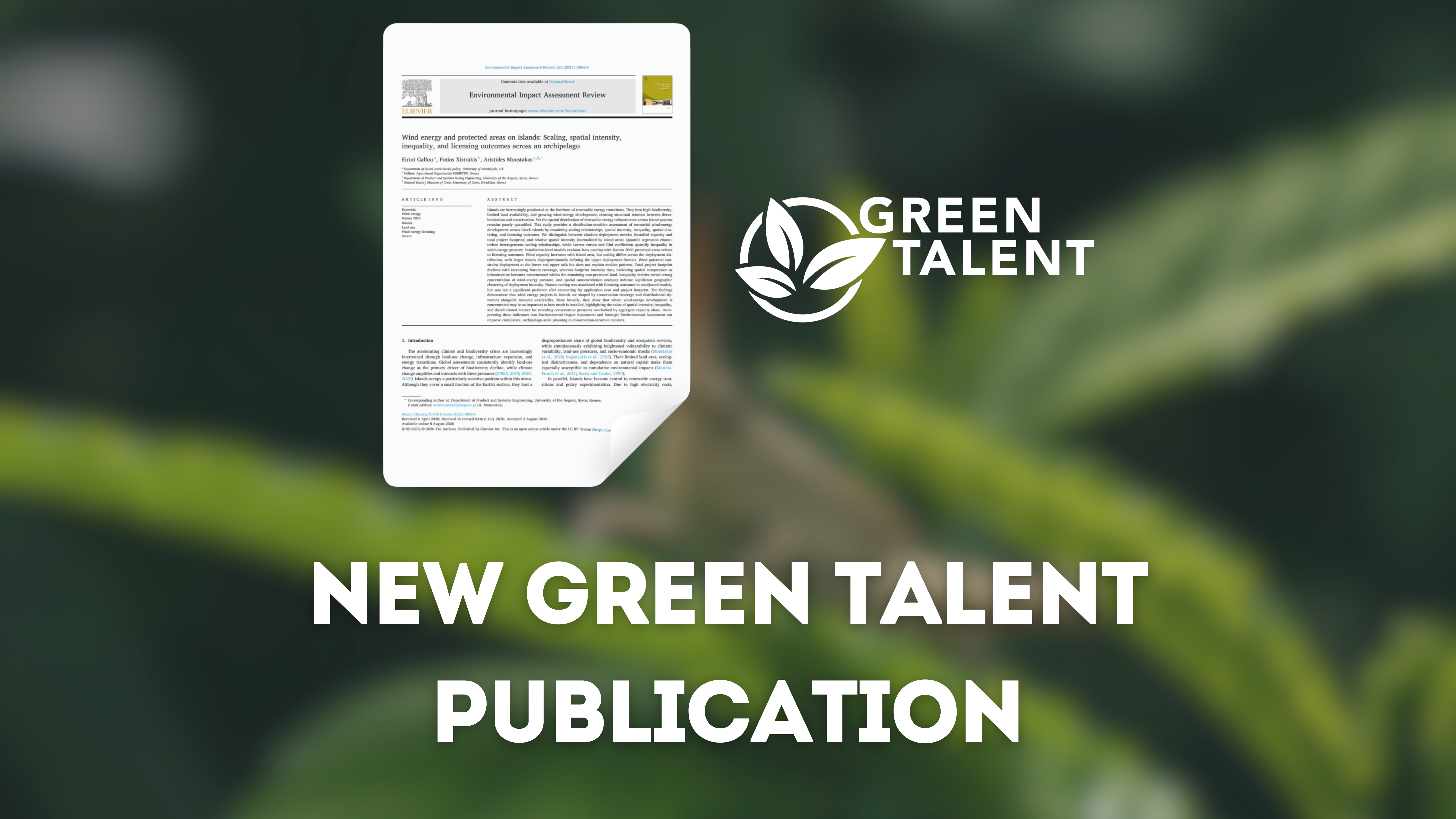
Green Talent is proud to announce a new scientific publication. Titled "Wind energy and protected areas on islands: Scaling, spatial intensity, inequality, and licensing outcomes across an archipelago”, the study is co-authored by project member Aristides Moustakas and can be accessed in the journal Environmental Impact Assessment Review, which collects peer-reviewed research on environmental planning and conservation science. The article provides an assessment of terrestrial wind-energy development across Greek islands, examining how renewable energy infrastructure is spatially distributed relative to biodiversity conservation priorities. Supported by Green Talent project, this article reflects the project's shared commitment to bridging the gap between ecological research in Widening Countries and the broader European scientific networks.
With a particular focus on Greek islands, this research examines the challenges between decarbonisation and conservation that arise where high biodiversity, limited land availability and growing wind-energy development intersect. The study distinguishes between absolute deployment metrics and relative spatial intensity normalised by island area. The findings show that wind capacity increases with island area but that this scaling differs across the deployment distribution, with larger islands disproportionately defining the upper deployment frontier. Results also show that as overlap with Natura 2000 protected areas increases, total project footprint declines, but footprint intensity rises. Interestingly, this indicates that infrastructure becomes compressed within the remaining non-protected land.
To conclude, this publication demonstrates the Green Talen project's capacity to support valuable research at the intersection of environmental science and sustainability policy-making at the European level. The study highlights the value of spatial intensity, inequality and distributional metrics for revealing conservation pressures that aggregate capacity figures happen to overlook.