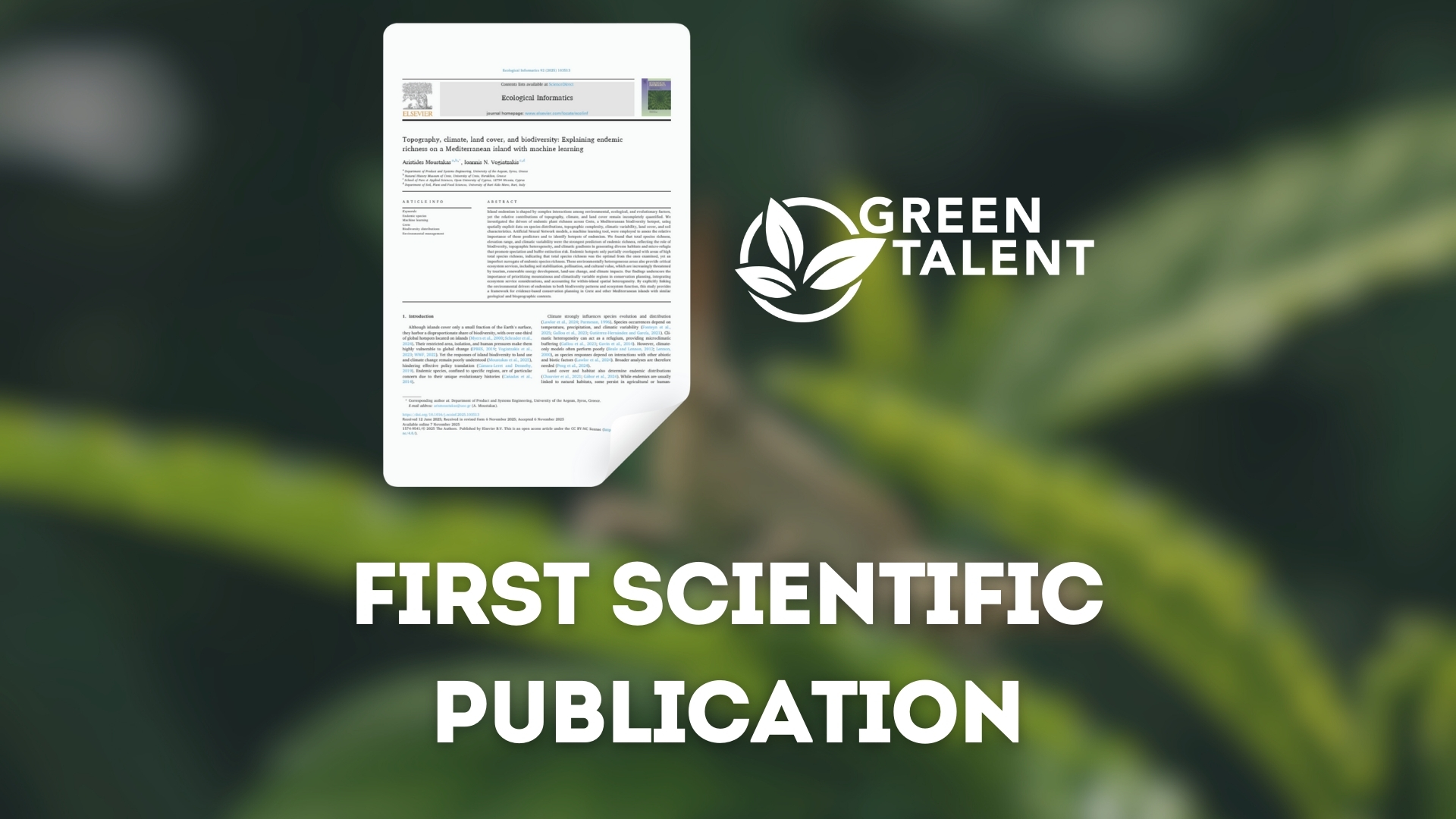
Green Talent is proud to announce a major milestone - the first scientific publication, supported by the project itself, has been officially published. Titled “Topography, climate, land cover, and biodiversity: Explaining endemic richness on a Mediterranean island with machine learning”, the study can be openly accessed in the journal of Ecological Informatics, collecting peer-reviewed articles on all aspects of computational ecology, data science, biogeography, and ecosystem analysis. The analysis includes a deep dive into the links between natural geography and land-use/land-cover that shape today’s biodiversity patterns. Supported by Green Talent, this article reflects the project’s shared commitment to bridging the gap between ecological research in Widening Countries and the broader European scientific networks.
With a particular focus on Crete and other Mediterranean islands, this research contains detailed analysis on how the correlation between biodiversity distribution and terrain and climatic conditions play a significant role in understanding the biodiversity richness of landscapes. In addition, the article covers the role of human intervention in examining species abundance, as well as the importance of using integrated data across climatic, geographic and ecological contexts to offer better methodological structures for future research. Findings of the study also show that environmentally heterogeneous areas provide crucial ecosystem services, such as soil stabilisation, pollination, and cultural value, being often put under threat due to increased tourism, renewable energy development, land-use changes and climate change challenges. Thus, the authors emphasise on the necessity of developing a framework for evidence-based conservation planning in mountainous and climatically variable regions, including Crete and various other islands in the Mediterranean.
As Green Talent’s first publication, this study demonstrates the project’s capacity to support valuable research at the intersection of environmental science, sustainability policy-making and European collaboration. Stay tuned as we continue to expand our research network and develop new research projects that correspond to Europe’s green transition agenda.